Tokyo – since 1932
The 1884 perpetual lease had no provision for reviewing the rent of the compound. The only way for the Japanese to terminate the lease would have been to require the land for ‘purposes of defence against a foreign or domestic enemy’ and to assign an alternative site to the British. The Japanese never invoked this clause, even during World War II.
There may have been Japanese dissatisfaction with the low rent that the British were paying but there is no record of significant exchanges on the topic until 1967 when the Japanese proposed a revised rent of ¥ 971,000 per annum for the whole compound, calculated by reference to the increase in land prices between 1944 and 1965 in the urban areas of the six largest cities in Japan. The British agreed to this figure in 1970, backdating the increase to 1 January 1968 and accepting that the rent should be subject to future adjustment from time to time, which was soon afterwards elaborated to mean at not less than 10 year intervals. The subsequent 1978 review arrived at a figure for the whole compound of ¥ 2.6m per annum, based again on the Six Cities Index and payable from 1 January 1978.
The 1988 review started with the Japanese asking for massive annual rent increases over the 10 years so as to begin approaching a commercial level. The British insisted on sticking to a flat annual rent but conceded a move to the more onerous 23 Special Wards Index based on central Tokyo values. The result, reached in 1990, was a revised rent of ¥ 12.6m per annum for 10 years from 1 January 1988.
The Japanese opened the 1998 review (which took until 2003 to agree) with a very high starting figure coupled with the demand for annual increases so as to reach ¥ 179.5m by 2007, asserting that even this figure would still be significantly below a proper commercial rent. The British were still only prepared to consider a flat rent, based on changes in the 23 Special Wards Index. Meanwhile, the embassy continued to pay rent at the rate agreed in the 1988 review until, at the end of 1999, the Japanese Ministry of Finance (MoF) declined to accept further instalments and introduced the new proposal that the British should return some of the compound land to the Japanese government. The British continued to reject any link with a commercial rent and opposed any surrender of land. In November 2002, the Japanese conceded that a flat rate might be acceptable if it was substantially higher than the 1988-1997 figure: they proposed ¥ 98m per annum which the British countered with ¥ 35m per annum, in itself a major concession from their former insistence on tracking index movements. The Japanese agreed exceptionally to this figure, while emphasising that it remained their ambition to pursue commercial values in the future.
Before the start of the 2008 review, the MoF insisted on pursuing massive rent increases that exceeded the 23 Special Wards Index to take effect on 1 January 2008 before considering any change in the freehold arrangements. Their proposal was an increase from the then current ¥ 35m per annum to ¥81m per annum for the first year followed by annual increases taking the rent to ¥ 148m per annum for the tenth year. Negotiations continued intermittently but no agreement was reached
The underlying problem was a combination of three factors: the restrictive terms of the 1884 lease, the extraordinary rise in Tokyo land values, and the emergence of a variety of commercial initiatives in Tokyo (including the involvement of third parties and private finance). The MoF relaxed its insistence on rental negotiations taking precedence over considerations about the return of some of the compound to the Japanese government. In 2002 it implied that there was the possibility of a substantial ‘sitting tenant’ discount if the British were to purchase the freehold of the compound. This relaxation was perhaps also due to two new influences: the Japanese Ministry of Foreign Affairs (MFA) had stepped in as an intermediary between foreign missions wrestling with the MoF about their lease problems, and the influx into Tokyo of western property consultants and operators.
The British were being advised by Colliers Halifax and DLA Piper, briefed and managed with great skill by Jeremy Neate, the FCO’s most senior estates surveyor. Neate outlined the problem and pointed to the solution in a 2010 paper (24 March). He argued that the FCO’s interest in the compound had no realisable value in the open market. In round and theoretical figures, the compound’s value to the FCO was represented by the money that the FCO was saving by not having to rent the accommodation elsewhere: this ‘existing use value’ was assessed at about £50m. The market value of the freehold to the Japanese Government, with FCO as an entrenched tenant disinclined to pay a market rent, was no more than £25 million. The compound’s value in the open market, if it was not encumbered by the lease’s perpetuity and its restriction to diplomatic use, however, would be assessed at about £450 million. There was therefore about £375m of latent value locked up by the 1884 arrangement. Neither government could unlock any of this value without the consent of the other. The only way to release it was through a ‘marriage value’ deal: that is, to agree a joint course of action and to share the benefits.
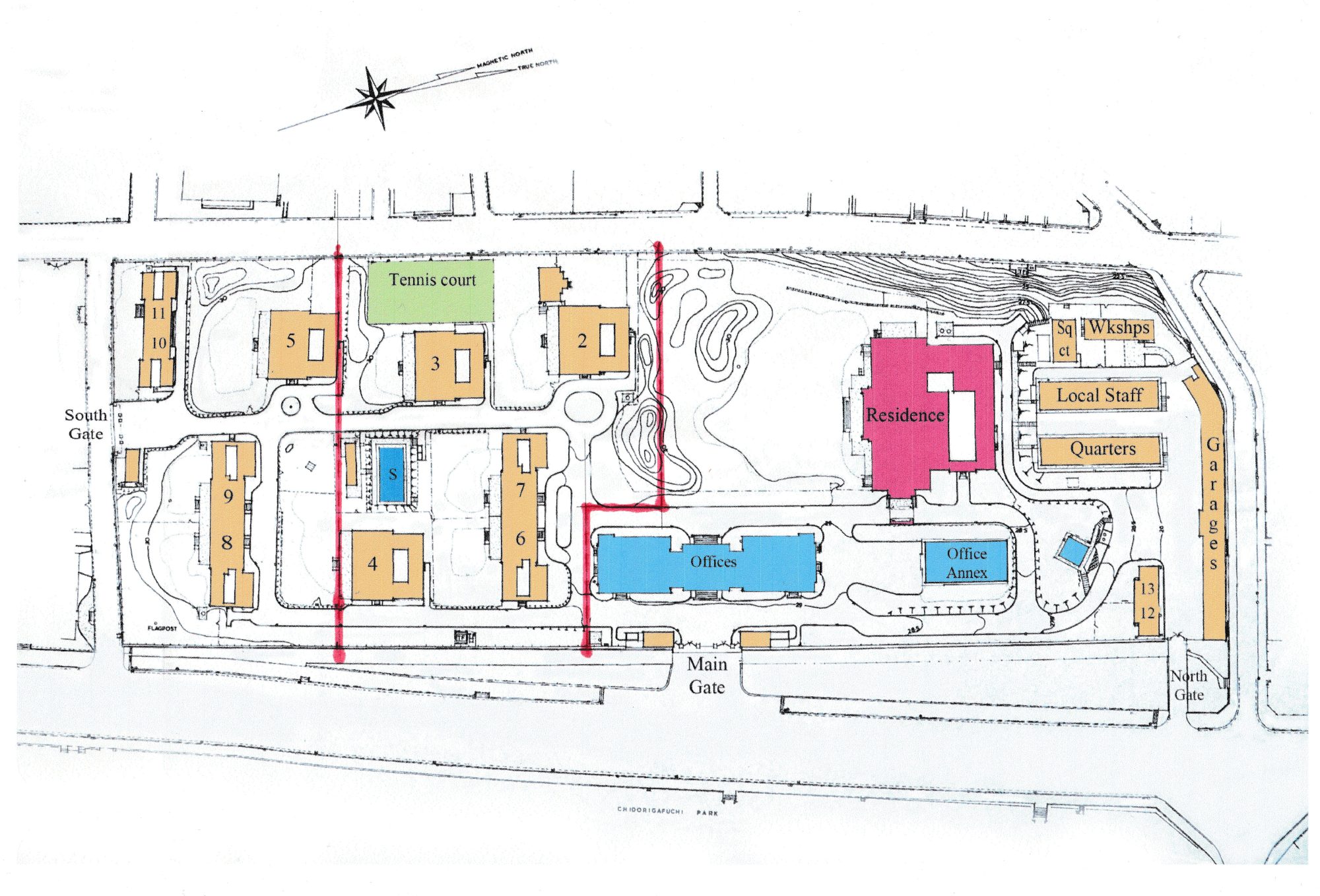
The 1972 compound plan showing the 2015-22 ownership re-arrangement, with the surrendered area on the left, the area sold for commercial development in the middle, and the area being retained by the embassy for its own longterm operational purposes on the right.
That is what was achieved through complex negotiations and agreements over the next twelve years. In summary, first, the British surrendered the southern 20% of the compound in 2015 in exchange for being granted the freehold of the remaining 80%. Second, in 2022, the British sold the freehold of about a third of that 80% for intensive development by a major Japanese property company. Third, the British retained the northern two thirds for their own long term embassy purposes. In a little more detail:
(1) The MoF required that at least 20% of the compound needed to be surrendered to the Japanese government before the MoF could transfer the freehold of the remainder to the British. The surrendered area was therefore 7,000 sqm (1.7 acres), as specified in an Agreement signed on 31 August 2015. The Japanese dedicated this area as an open park that, beautifully laid out and planted, opened to the public in May 2023, and is now called Hanzomon Square Garden (also Hanzomon Enchi Park).
(2) The area sold for development comprised 9,300sqm (2.3 acres). To maximise its development potential, the British transferred to this land the development rights accruing to the adjacent land that it was retaining. The site was subsequently bought by Mitsubishi Estate Group in 2022 for the enormous sum of £685m in 2022: a 14-storey block of high-end apartments is (2026) under construction on the site.
(3) The Japanese prescribed that not more than two hectares (20,000sqm) of freehold land should be retained by the British: the eventual retained area was 19,000sqm (4.7 acres). The British have embarked on re-fashioning the 1930s residence and chancery block, and other buildings on this retained land.
 Room for Diplomacy